The Ultimate Guide to Startup Funding in India (2026 Edition)
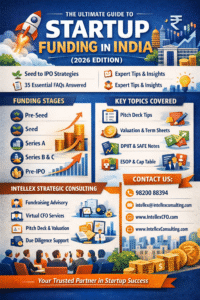
A complete 2026 guide to startup funding in India covering seed to IPO, 35 essential FAQs, pitch deck strategy, valuations, term sheets, DPIIT, SAFE notes, and expert fundraising support from Intellex Strategic Consulting.
This guide serves as a comprehensive manual for Indian founders navigating the complex world of capital raising. From seed rounds to IPOs, we break down everything you need to know.
- Also Read: Top 10 Angel Investment Networks in India (2026): The Ultimate Founder’s Guide to Fundraising.
Understanding the Indian Funding Landscape
The Indian startup ecosystem has matured significantly. In 2026, the focus has shifted from “growth at all costs” to “sustainable unit economics” and “deep-tech innovation.” Whether you are a “Bharat-first” entrepreneur or building a global SaaS platform, securing the right capital at the right time is the lifeblood of your venture.
The Stages of Growth and Funding Needs
- Pre-Seed (Ideation): Focus on prototyping and market research. Sources: Bootstrapping, Friends & Family, Grants.
- Seed (Validation): Proving product-market fit (PMF). Sources: Angel Investors, Micro-VCs, Incubators.
- Series A (Early Traction): Scaling the proven model. Sources: Venture Capital (VC) Funds.
- Series B & C (Expansion): Market expansion and hitting high-growth milestones. Sources: Growth Funds, Private Equity.
- Series D+ & Pre-IPO: Preparing for a public exit or massive acquisition.
Top 35 FAQs on Startup Funding in India
Section 1: The Basics of Fundraising
1. What is the right time to start looking for funding?
Ideally, start 6 months before you run out of cash. You should seek funding when you have reached a milestone that proves your business’s value such as a working prototype, initial revenue, or a significant user base.
2. What is the difference between Pre-Money and Post-Money Valuation?
Pre-money is what your company is worth before you receive the investment. Post-money is the pre-money valuation plus the amount of cash invested.
3. What is a “Burn Rate”?
This is the amount of money your startup is losing each month. Investors look at “Gross Burn” (total monthly expenses) and “Net Burn” (expenses minus revenue) to calculate your “Runway.”
4. How much equity should I give away in a Seed round?
Commonly, founders dilute between 10% to 25% in a seed round. Giving away too much early on can make you “uninvestable” in later rounds because founders need enough “skin in the game.”
5. What is a “Term Sheet”?
A non-binding document that outlines the key terms and conditions of an investment. It serves as a template for the final legal agreements.
Section 2: Pitching and Investor Relations
6. What are the 3 most important slides in a pitch deck?
- The Problem: Is it big enough to solve?
- The Solution/Product: Is it unique and scalable?
- The Team: Can you actually execute this?
7. How do I find the right Angel Investors in India?
Use platforms like LinkedIn, AngelList (Wellfound), and networks like Indian Angel Network (IAN) or Mumbai Angels. Look for investors who have backed companies in your specific sector.
8. What is “Due Diligence”?
The process where an investor verifies your claims. This includes legal audits, financial audits, background checks on founders, and speaking to your customers.
9. What do VCs mean by “Unit Economics”?
They want to know if you make money on a single transaction after all costs. Key metrics include Customer Acquisition Cost (CAC) and Lifetime Value (LTV).
10. Is it better to have one large investor or many small ones?
A “Lead Investor” (one who takes the majority of the round) is usually preferred as they set the terms and provide a stronger signal to the market.
Section 3: Legal and Regulatory (The Indian Context)
11. What is the “Angel Tax”?
Historically, this was a tax on capital raised by unlisted companies above “fair market value.” While regulations have eased significantly for DPIIT-recognized startups, it is vital to ensure your valuation is supported by a Chartered Accountant or Merchant Banker.
12. Why should I register with DPIIT?
DPIIT (Department for Promotion of Industry and Internal Trade) recognition gives you access to tax holidays, easier compliance, and government seed fund schemes.
13. What is a SAFE Note (or iSAFE in India)?
Simple Agreement for Future Equity. It’s a popular instrument for seed rounds where investors provide cash now in exchange for equity later during a priced round.
14. Can foreign VCs invest in Indian startups?
Yes, via the FDI (Foreign Direct Investment) route. However, compliance with FEMA (Foreign Exchange Management Act) is mandatory.
15. What is an ESOP Pool?
Employee Stock Option Plan. Investors usually require you to set aside 10-15% of equity for future hires before they invest.
Section 4: Advanced Funding Strategies
16. What is Venture Debt?
It is a loan for startups that have already raised VC money. It doesn’t dilute equity but must be repaid with interest.
17. What is a “Down Round”?
When a company raises money at a lower valuation than its previous round. This usually triggers “anti-dilution” clauses for earlier investors.
18. How does a Bridge Round work?
A small funding round designed to keep the company afloat until a larger, “priced” round is closed.
19. What is a “Cap Table”?
A spreadsheet showing the ownership stakes (equity) of all founders, employees, and investors.
20. What is a “Moat”?
A competitive advantage (like a patent, network effect, or high switching costs) that protects your business from competitors.
Section 5: Strategic Advice for Founders
21. Should I hire a consultant for fundraising?
Yes. Professional advisors like Intellex Strategic Consulting help in fine-tuning your business model, preparing professional pitch decks, and connecting you with the right global and Indian investors.
22. What is the “Bharat-first” strategy?
Building products specifically for the next 500 million internet users in Tier 2 and Tier 3 cities in India.
23. How do I calculate my TAM, SAM, and SOM?
- TAM (Total Addressable Market): Everyone who could use your product.
- SAM (Serviceable Addressable Market): The portion of TAM that fits your business model.
- SOM (Serviceable Obtainable Market): What you can actually capture in 3-5 years.
24. What are “Liquidation Preferences”?
A clause that determines who gets paid first and how much during an exit (sale or IPO).
25. Can I raise funds without a revenue-generating product?
Yes, at the Pre-Seed or Seed stage, if the “Problem” is massive and the “Team” is exceptional.
26. How do I handle a “No” from an investor?
Ask for feedback. A “No” today could be a “Yes” in the next round if you show progress on the areas they were worried about.
27. What is a “Clawback” provision?
A clause that allows investors to take back equity or bonuses if certain performance targets aren’t met or if there is fraud.
28. How important is the Founder’s Agreement?
Critical. It outlines how decisions are made, what happens if a founder leaves (Vesting), and intellectual property ownership.
29. What is “Dry Powder”?
The amount of cash VC funds have available to invest but haven’t deployed yet.
30. What is an “Exit Strategy”?
How investors get their money back—usually through an Acquisition, Secondary Sale, or IPO.
- Also Read: What Angel Investors Look for in Indian Startups (2025 Insights Every Founder Should Know)
31. What is the role of a Virtual CFO during fundraising?
A Virtual CFO ensures your “books” are investor-ready, manages the data room for due diligence, and builds complex financial projections.
32. What is “Growth Hacking”?
Low-cost, creative strategies to acquire as many users as possible quickly.
33. How do I protect my Idea?
Execution is more important than the idea. However, use Non-Disclosure Agreements (NDAs) only when sharing highly sensitive IP (Intellectual Property).
34. What is a “Unicorn” vs. a “Soonicorn”?
A Unicorn is a startup valued at over $1 billion. A Soonicorn is a “Soon-to-be-Unicorn.”
35. Why do most startups fail to raise funds?
Usually due to a lack of market need, poor team dynamics, or a business model that isn’t scalable.
How Intellex Strategic Consulting Can Help You
Raising funds is a full-time job that can distract you from building your product. This is where Intellex Strategic Consulting Pvt Ltd steps in as your strategic partner.
With platforms like IntellexCFO.com and IntellexConsulting.com, we provide a “One-Stop Solution” for startups in India and globally.
Our Core Services Include:
-
- Fundraising Advisory: Connecting you with Angel Networks, VCs, and Private Equity players.
- Pitch Deck & Business Plan Preparation: Crafting narratives that investors can’t ignore.
- Valuation Services: Professional business valuation to ensure you don’t over-dilute.
- Virtual CFO Services: End-to-end financial management and investor reporting.
- Due Diligence Support: Managing the “Data Room” and legal compliance.
- Strategic Growth Consulting: Refining your Go-To-Market (GTM) strategy.
Get in Touch with Intellex Today:
- WhatsApp: 98200-88394
- Email: intellex@intellexconsulting.
com - Websites: IntellexCFO.com | IntellexConsulting.com
Conclusion
Fundraising is a marathon, not a sprint. By understanding these FAQs and preparing your documentation early, you position your startup as a professional, low-risk investment. Don’t go it alone—leverage the expertise of seasoned advisors to ensure your vision gets the capital it deserves.
Team: Intellex Strategic Consulting Pvt Ltd